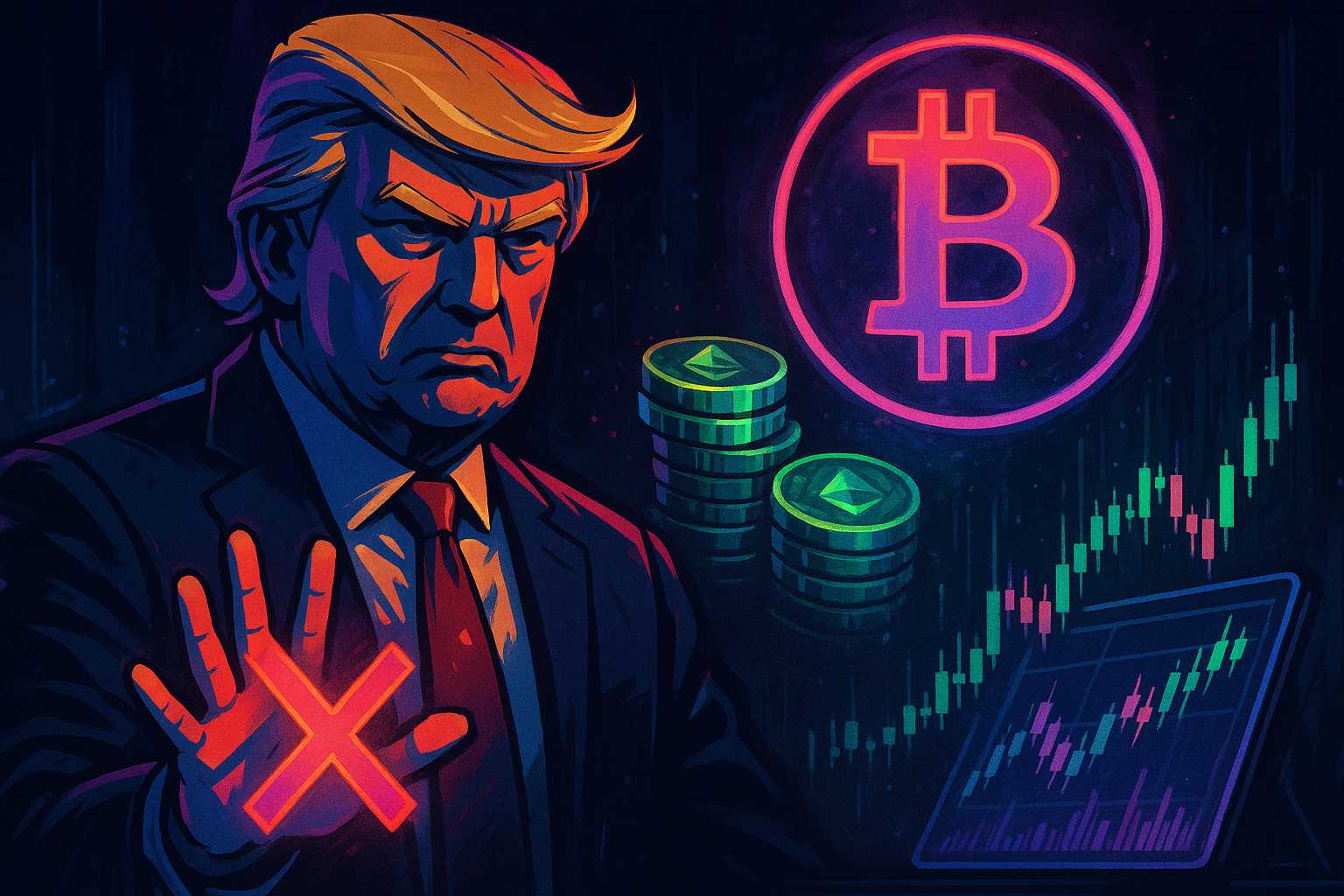
The 'Crypto President's' Own Media Company Just Quit the Bitcoin ETF Market Before Selling a Single Share
The man who called himself the “crypto president” watched his own company quietly surrender to the Bitcoin ETF market yesterday — without ever selling a share.
On May 19, 2026, Trump Media & Technology Group filed Form RW documents with the SEC to withdraw all three of its spot crypto ETF applications: the Truth Social Bitcoin ETF, the Truth Social Bitcoin & Ethereum ETF, and the Truth Social Crypto Blue Chip ETF. The original filings had been submitted between June and July 2025. None were ever declared effective. No securities were sold.
The filing is three sentences. It just says they “determined to withdraw the Registration Statement and not to pursue the public offering at this time.”
That’s it. No press release. No explanation. Just gone.
What Happened
Truth Social’s ETF products were managed by its investment advisor Yorkville America Digital. Their official line is a pivot story: they’re refiling under the Investment Company Act of 1940 (the “‘40 Act”) instead of the Securities Act of 1933 (the “‘33 Act”). That’s a regulatory difference — funds registered under the ‘40 Act have different structural and reporting requirements.
But analysts aren’t buying the spin.
The real story is the fee war that is eating the Bitcoin ETF industry alive. When BlackRock launched IBIT in January 2024, it repriced the entire market. Today, the U.S. spot Bitcoin ETF space manages more than $57.4 billion in assets — and the fee race to zero has made it nearly impossible for new entrants to compete.
BlackRock charges 0.25%. Fidelity charges 0.25%. Invesco and Galaxy cut theirs to 0.39%. Morgan Stanley just launched MSBT, immediately dropping fees to compete. When a new player — especially one with zero track record in fund management — tries to enter this market, institutional allocators look at the fee, the brand, the track record, and the liquidity. Truth Social has exactly one of those things (a brand), and it’s polarizing at best.
Beyond fees: Bitcoin ETF flows have turned deeply negative in recent weeks. More than $2.1 billion has left spot BTC ETF funds across six consecutive trading sessions heading into this week. BlackRock’s IBIT alone saw over $1 billion in outflows. Even the strongest players are bleeding. A brand-new, unproven ETF from a media company with no asset management history would have faced an uphill battle just to gather assets in a bull market. In this environment, it was dead on arrival.
The Politics of It
There’s a layer of irony that’s hard to ignore.
Trump has been one of the most aggressive pro-crypto presidents in U.S. history: strategic Bitcoin reserve, Fed master account access for crypto firms, SAB 121 reversal, GENIUS Act for stablecoins. The administration has done more to legitimize the industry in 18 months than the previous decade combined.
And yet the company bearing his name — the one that launched a “Crypto Blue Chip ETF” branded around his political identity — couldn’t hack it in the open market. The crypto industry Trump helped legitimize has become so competitive, so institutional, so ruthless on fees and flows, that a Trump-branded ETF couldn’t survive.
That’s actually kind of bullish for the space. The market doesn’t care about branding. It cares about basis points.
What This Means for the ETF Product Landscape
The withdrawal signals something important: the easy phase of spot crypto ETF creation is over. The first movers captured the AUM. The fee compression is now structural. Any new entrant needs either:
- A differentiated product (specific sectors, staking yield, active management)
- An enormous distribution network already in place
- A rock-bottom fee structure from day one
Truth Social had none of those. Most late entrants in 2026 don’t either.
What does survive: thematic ETFs (DeFi, Layer 2, AI x crypto), staking-yield products, and actively managed digital asset funds targeting institutional allocators who want a story beyond “we bought spot BTC.”
Why This Matters for Crypto Jobs
The brutal consolidation in the ETF market is reshaping where hiring happens in crypto finance. The winners — BlackRock, Fidelity, VanEck — are scaling up compliance, product management, and institutional sales teams. The losers are quietly pulling filings.
For builders in the job market right now:
- ETF product roles are concentrating at established TradFi firms with distribution muscle, not crypto-native startups
- Compliance and regulatory roles are hot as the ‘40 Act vs. ‘33 Act debate creates new structuring complexity — firms need lawyers and compliance officers who understand both worlds
- Crypto-native asset managers are differentiating via DeFi yield strategies and staking ETPs — that’s where engineering and quant roles are growing
- Marketing and brand roles at crypto ETF shops are increasingly important: in a commoditized fee market, distribution is everything and distribution depends on narrative
The spot BTC ETF gold rush is over. The next wave is structured products, yield strategies, and institutional wrappers for DeFi. That’s where the jobs are being built.
Looking for your next role in crypto finance or Web3? Browse hundreds of open positions at Cryptogrind — the job board built for builders, not bots.



Discussion
Comments are powered by GitHub. Sign in with your GitHub account to chime in.