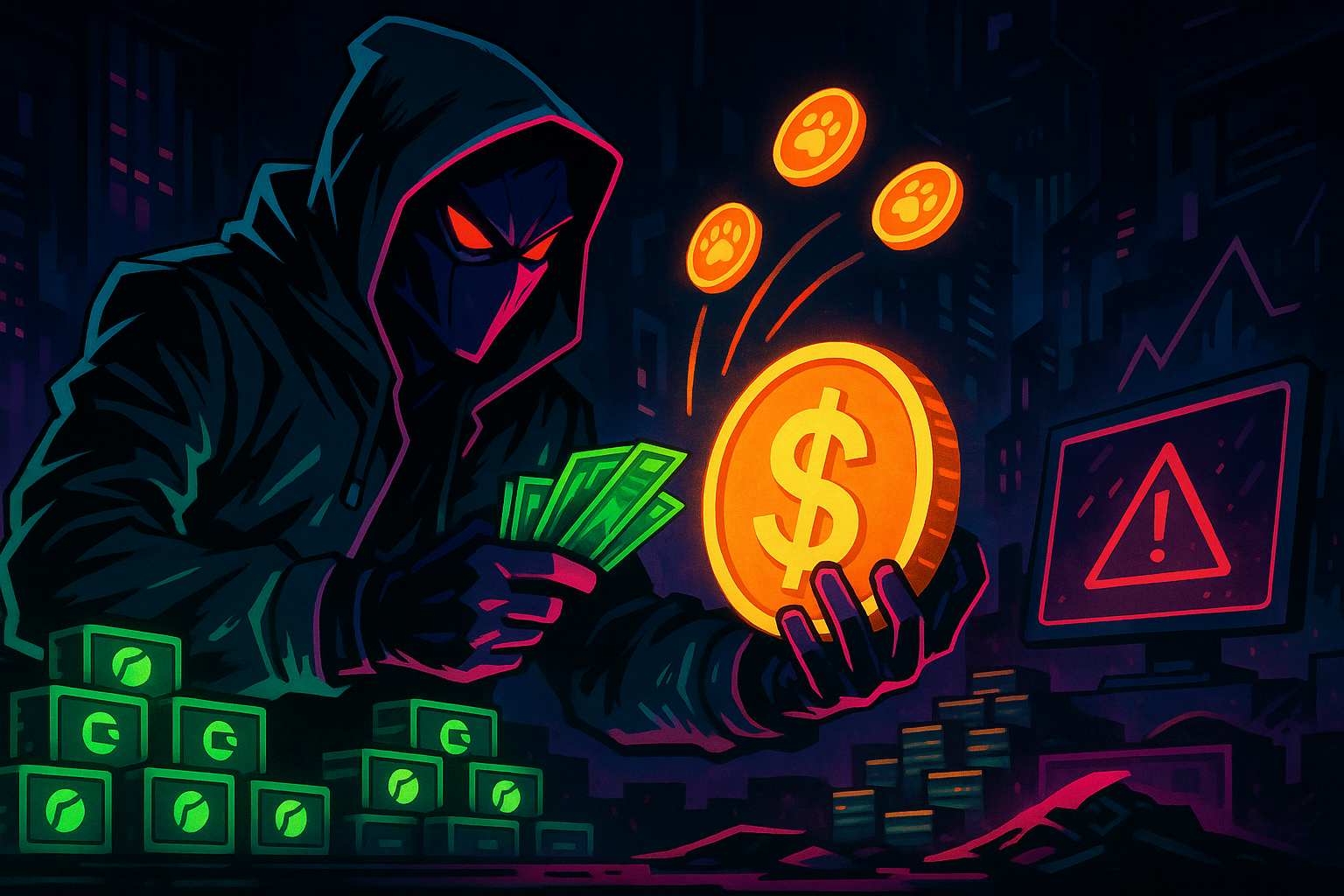
53 Memecoins on Robinhood Chain Turned Out to Be One Crew. They Took $18.4M, and Each Rug Paid for the Next
For two and a half months, Robinhood Chain looked like it had a busy memecoin scene: CRUMBS, LEGS, PINK, DEED, DRAFT, EQUITY and dozens of other launches, each with its own chart, its own holders and its own moment of hype.
According to a new onchain investigation, 53 of those launches came from the same crew.
On Sunday, pseudonymous analyst Wazz (@WazzCrypto) published a thread tying 53 memecoin launches on Robinhood Chain, between July 10 and September 21, to a single operation that extracted at least $18.43 million from buyers. The Block, which first reported the findings, summed up the business model in one of Wazz’s lines:
“The proceeds of one launch pay the key that funds the next.”
It was a conveyor belt of rugs, running on a chain that went live on July 1.
How One Crew Became 53 “Communities”
This wasn’t a dev who happened to rug twice. According to Wazz’s analysis as reported by The Block and Crypto Briefing, the playbook went like this:
- Wallet armies. Most launches used bundles of 70 to 200 wallets to take over 70% of a token’s supply before the public had a real chance to buy. To anyone checking the holder list, it looked like a spread-out community. It was really one group.
- Tax exemptions for insiders. Token creators exempted 15 to 25 of their own wallets from the anti-sniping tax on Pons V2, the chain’s main launchpad. The feature built to stop snipers ended up letting the insiders buy tax-free.
- Supply grabbed in seconds. Single transactions bought 82-86% of a token’s supply within seconds of launch.
- Fake contracts first. Some launches put out fake “pre-launch” contracts to pull buyers in before the real contract address was released.
- An off-the-shelf tool. A commercial bundling contract, created August 28, was used in 25 of the 53 launches.
Then came the dump, and the cash went on to fund the next launch.
The Receipts
Wazz linked the launches in three ways:
- 45 launches connected by direct wallet-to-wallet fund flows
- 4 launches funded from the same private key
- 4 launches that sent proceeds to a common collector wallet
The biggest extractions:
| Token | Extracted |
|---|---|
| CRUMBS | ~$3.12M |
| LEGS | ~$2.9M |
| PINK | ~$1.44M |
The token that started the investigation, DEED, turned out to be a small one. On its own it paid out 130.75 ETH from Uniswap pool sales plus 69.06 ETH in creator fees, and it still didn’t make the operation’s top 10. Some of the money has already moved: on September 24, 86.5 ETH went through the Relay bridge to Ethereum and came out as roughly 231,000 DAI.
Wazz also warns that $18.43M is a floor, not a final total. The analysis flagged two more serial operations on the chain that aren’t linked to this group and aren’t counted in the figure.
As of publication, The Block said it had asked Pons and Robinhood for comment. Neither had responded publicly.
The Awkward Part for Robinhood
Robinhood Chain is an Ethereum L2 built on Arbitrum’s Orbit stack. Robinhood pitched it as the home for tokenized stocks, 24/7 trading and AI trading agents, which we covered at launch. The Block notes that memecoins and stock tokens have been driving most of the activity since, and that Pons pushed the chain to a record of about $6 million in daily fees.
So some of the chain’s best usage numbers were built partly on launches this analysis ties to one extraction ring. That’s the same pattern Solana went through with pump.fun: open token launches bring in activity, and the activity brings in people who rig launches at scale. Robinhood Chain got there in under three months.
It also adds to a bad month for Robinhood’s crypto side, after two Robinhood engineers were charged with front-running their own company’s listings on Hyperliquid earlier in September. Robinhood doesn’t run Pons and didn’t launch these tokens. But the retail users it brought onchain are the ones who bought the tops.
Unconfirmed: Nobody has identified the people behind the operation, and no law enforcement action has been announced. Everything above comes from public onchain data as analyzed by Wazz and reported by The Block, Crypto Briefing and The Cryptonomist.
Why This Matters for Crypto Jobs
Onchain investigators are doing the work that platforms aren’t. One pseudonymous analyst traced 53 launches, three linking methods and a bridge exit. Firms like TRM, Chainalysis and Elliptic hire for exactly that skill, and so do exchanges, launchpads and a growing number of L2 teams that need it in-house. A public investigation like this one works as a portfolio. If you can trace funds, cluster wallets and write it up clearly, you’re employable.
Launchpad and L2 teams need trust & safety people now. An anti-sniping tax that creators can switch off for their own wallets is a design flaw, not a bug in some edge case. Expect launchpads to hire smart contract engineers and product security people to close loopholes like that, and expect L2 teams, especially ones with a brand like Robinhood’s, to start hiring risk, fraud and T&S analysts before regulators ask why they weren’t.
Compliance at consumer-facing chains is going to grow. Robinhood is a regulated US broker. When its own chain turns up in a $18M rug-pull investigation, the likely response is more compliance, monitoring and investigations headcount, not less.
Degens, take note: if 70% of the supply sits in 200 fresh wallets funded from the same place, you’re not early. You’re the exit liquidity.
Want to be the one tracing the rugs instead of buying them? Cryptogrind lists live openings for onchain analysts, security engineers, smart contract developers and compliance roles across crypto and Web3. Find your next role at Cryptogrind.

Discussion
Comments are powered by GitHub. Sign in with your GitHub account to chime in.