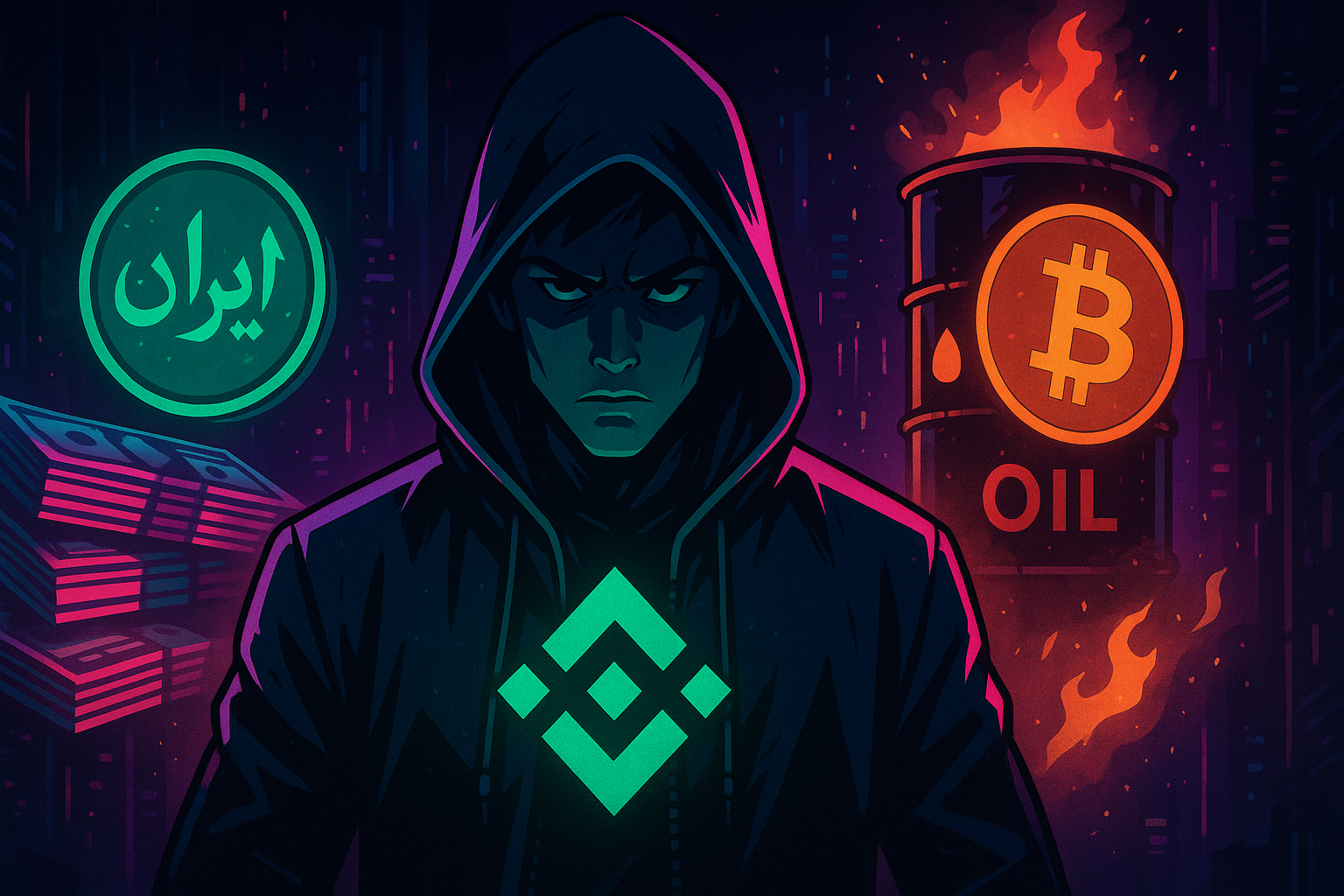
Last Week Manhattan Prosecutors Moved to Seize $61M of Iranian Oil Money That Ran Through Binance. This Week They're Investigating Binance
On September 15, the US Attorney’s Office for the Southern District of New York filed a civil forfeiture complaint to claw back roughly $61 million in crypto it says was black-market Iranian oil money, laundered by two Chinese front companies through Binance trading accounts.
On September 22, Bloomberg reported that the same office is now investigating Binance itself.
According to people familiar with the matter cited by Bloomberg, federal prosecutors are examining whether Binance violated US sanctions on Iran by failing to stop certain trading on its platform. The Manhattan US Attorney’s office is leading the probe. The Justice Department’s Criminal Division in Washington is also involved. The specific question prosecutors are asking, per the report, is whether Binance knowingly allowed the trading to continue. Reuters confirmed the substance of the Bloomberg report. The DOJ declined to comment.
Binance’s statement, in full: “We maintain a zero-tolerance policy for sanctions violations. We fully cooperate with law enforcement, and we remain committed to rooting out and shutting down bad actors.”
It did not say whether it is aware of the investigation.
The Company That Already Pleaded Guilty to This
The reason “knowingly” is the word that matters is that Binance has been here before.
In November 2023, Binance pleaded guilty to conspiracy to violate the Bank Secrecy Act, failing to register as a money transmitter, and violating the International Emergency Economic Powers Act, the statute behind US sanctions. It paid $4.3 billion. Founder Changpeng Zhao pleaded guilty personally, stepped down as CEO, and served four months in prison. As part of the deal, Binance accepted two independent compliance monitors with three-year terms: Frances McLeod of Forensic Risk Alliance, chosen by the DOJ, and Sharon Cohen Levin of Sullivan & Cromwell, chosen by FinCEN. Both started in 2024.
Then the ground shifted. In September 2025, Bloomberg reported the DOJ was weighing whether to lift the monitor requirement early. In October 2025, President Trump pardoned CZ. Binance’s official line since then has been that “since 2024, Binance has transformed and built a best-in-class compliance program.”
The question the Southern District is now asking is whether that program let Iranian money keep flowing anyway.
Seven Months of Receipts
This investigation did not appear out of nowhere. It is the tail end of a paper trail that has been building since February.
- February 23, 2026: The Wall Street Journal reported that Binance’s internal investigators had flagged about $1.7 billion moving from Chinese clients into digital wallets used by Iranian financing networks. More than $1 billion of that reportedly ran through a Hong Kong payments company called Blessed Trust. The Journal also reported that Binance had fired staff who raised compliance concerns. Binance denied it: “Binance categorically did not dismantle any compliance investigation.”
- March 11, 2026: The Journal reported the DOJ was examining whether Iran used Binance to evade sanctions. Binance sued Dow Jones for defamation in the Southern District of New York the same day.
- April 17, 2026: Senator Richard Blumenthal wrote to the DOJ and FinCEN demanding to know the status of Binance’s two monitors, citing “mounting allegations of dangerously lax anti-money-laundering prevention.” Neither monitor responded publicly.
- May 22, 2026: The Journal reported that sanctioned Iranian financier Babak Zanjani moved about $850 million over two years on Binance, mostly through a single account, and that Binance’s internal team had flagged a network of accounts tied to the exchange Zedcex as a “high-risk” sanctions-evasion and terrorist-financing concern. Despite repeated internal alerts triggered by logins from devices in Tehran, the most recent in November 2025, the main account reportedly stayed open for more than 15 months after first detection. Binance said it “categorically did not directly transact with any sanctioned entities.”
- September 15, 2026: The SDNY forfeiture complaint. Two Chinese companies, Blessed Trust and Hexa Whale, allegedly used Binance accounts to convert and move proceeds from Iranian crude sales, feeding a cluster of unhosted wallets prosecutors call “Entity A” that received and distributed more than $1.5 billion for IRGC-linked entities and Iranian exchanges. Deputy US Attorney Sean S. Buckley: “Today’s action demonstrates our determination to deprive the Government of Iran and its terrorist proxies of the illegal money they rely on.”
- September 22, 2026: The Bloomberg report that Binance is the subject, not just the venue.
Read that list again and notice one name appears twice. Blessed Trust is the company the Journal says Binance’s own compliance team flagged in early 2026. It is also the company named in a federal forfeiture complaint filed by the office now investigating Binance. If prosecutors can show that Binance identified those flows internally and kept the accounts open, “knowingly” stops being a hard word to prove.
None of this establishes wrongdoing. An investigation is not a charge. Binance has a defamation suit pending against the Journal over the underlying reporting, and the specific timeframe and dollar figures under examination by prosecutors have not been made public.
But the stakes are different from the first time. The 2023 plea deal was a deferred-consequences arrangement: pay, accept monitors, fix it. A second sanctions case against a company that already admitted to sanctions violations would not be a settlement negotiation. It would be a breach.
Why This Matters for Crypto Jobs
Binance is the largest employer in centralized crypto and the reference point for every exchange compliance program on earth. When it is under a second federal sanctions investigation two years into a monitorship, the hiring implications land everywhere at once.
- Sanctions screening is the hottest compliance skill in the industry, again. The alleged failure mode here is not a missing rule. It is flagged accounts that stayed open. Every exchange, custodian and stablecoin issuer now needs people who can prove, to a monitor and to a prosecutor, that an escalation actually closed the account. If you have run sanctions investigations at a bank, an OFAC-facing fintech, or a chain-analytics firm, exchanges will pay for you this quarter.
- The “who reports to whom” question is back. The Journal’s reporting alleges staff who escalated were fired. Whether or not that is true, it is the first question any senior compliance hire should ask Binance, or any exchange: what happened to the last person who pushed back? Companies with a clean answer will win the talent war. Companies without one will pay a premium and still lose people.
- Monitorship work is a career. Forensic Risk Alliance and Sullivan & Cromwell have been embedded at Binance since 2024, and a second probe means the monitors are not going anywhere early. Forensic accountants, transaction-monitoring engineers and regulatory lawyers who can work inside a monitorship are in demand at the monitors, at the exchanges being monitored, and at every competitor trying to avoid one.
- Onchain intelligence is the evidence now. The SDNY complaint traces $1.5 billion through unhosted wallets to IRGC-linked entities. That analysis was done by people with Chainalysis, TRM and Elliptic skills, and prosecutors are clearly buying more of it. If you can follow money across chains and write it up so a judge can read it, the DOJ, the exchanges and the analytics vendors are all hiring.
- Exchange risk just got priced into offers. Engineers and product people weighing a Binance offer against Coinbase, Kraken or OKX should factor in that a second criminal case could mean more regional exits, more licence fights and more hiring freezes. Ask about it in the interview.
Compliance used to be the department you hired to keep regulators quiet. At Binance it is now the department that decides whether the company gets charged twice. Browse the latest crypto and Web3 jobs on Cryptogrind, including compliance, sanctions, investigations and risk roles at exchanges that would rather hire you now than explain to a prosecutor why they didn’t.
Discussion
Comments are powered by GitHub. Sign in with your GitHub account to chime in.