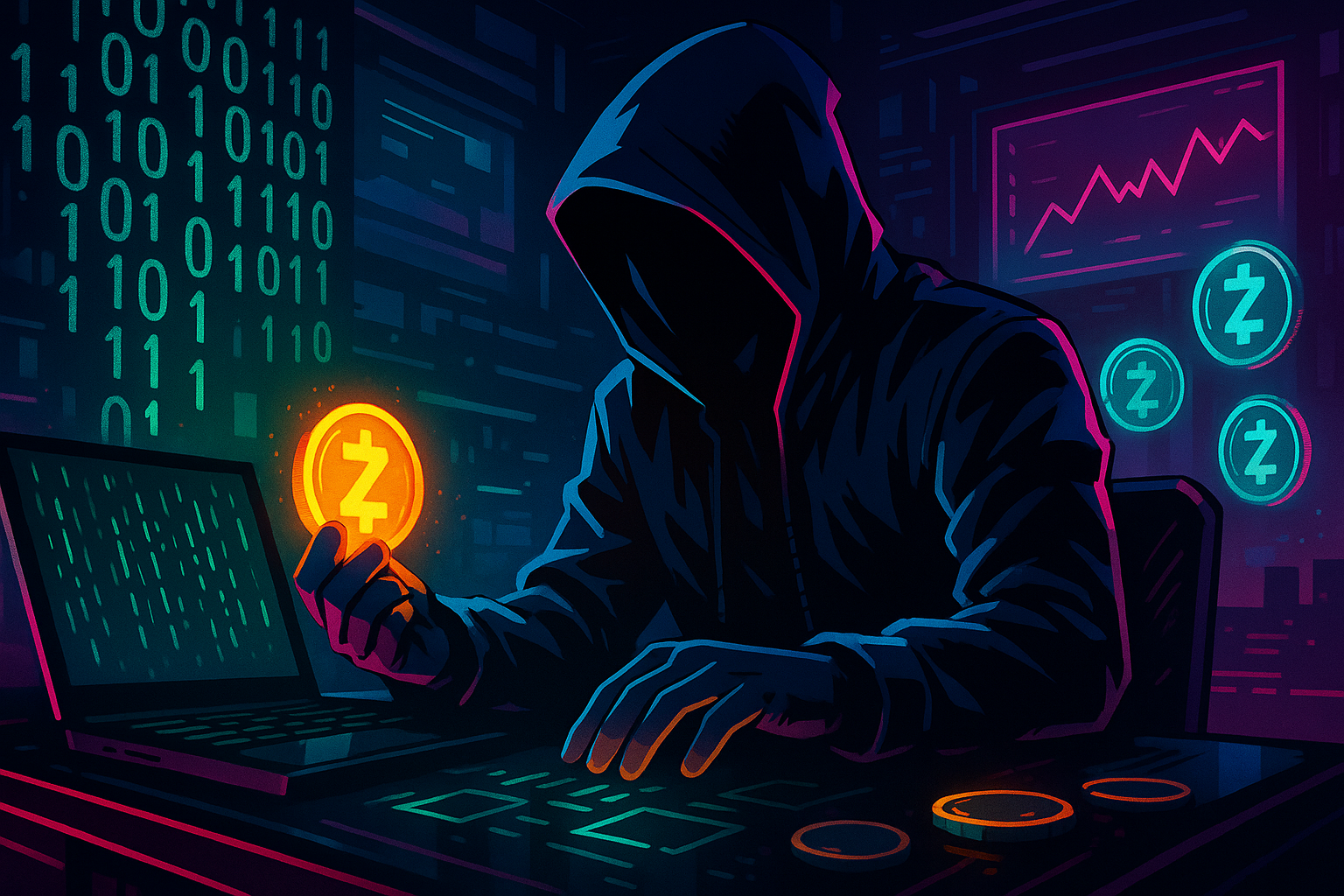
An AI Just Proved You Could Print Infinite Zcash — And Nobody Knows If Someone Already Did
For four years, anyone who found the right bug could have secretly minted unlimited Zcash. An AI found it. The fix is live. The supply? Unknowable. Forever.
That’s not FUD. That’s the official position of Shielded Labs, the team that maintains Zcash’s Orchard pool — the privacy layer at the heart of the network.
On June 5, 2026, Zcash founder Zooko Wilcox disclosed a critical vulnerability in the Orchard pool’s cryptographic circuit. The bug had been live since the NU5 upgrade in May 2022. Security engineer Taylor Hornby of Shielded Labs discovered it on May 29 using AI-assisted formal methods — specifically, Anthropic’s Claude Opus 4.8. An emergency hard fork was deployed by June 3. And then Zcash’s own privacy architecture delivered the gut punch: there is no cryptographic way to know whether the bug was ever used.
ZEC crashed 38%.
The Bug: Counterfeit Money With A Perfect Alibi
The vulnerability sat inside the halo2_gadgets crate — the code that powers Orchard’s zero-knowledge proofs. Specifically, it was an insufficient constraint in an elliptic-curve multiplication check. In plain English: the circuit was supposed to reject invalid transactions. A crafted input could trick it into accepting them anyway.
Hornby didn’t just find it in theory. He wrote a complete proof-of-concept exploit and tested it locally. It worked. He successfully generated counterfeit ZEC that passed Orchard’s own verification. Unlimited. Undetectable. At least in a test environment.
The fix required a coordinated emergency hard fork that activated June 3 — an unusually fast turnaround that suggests the Zcash team understood immediately how serious this was.
But here’s the problem no hard fork can fix.
The Unauditable Nightmare
Orchard’s privacy model is the whole point of Zcash. Shielded transactions are designed to be cryptographically opaque. That’s the feature. It’s also now the liability.
Because the pool hides all transaction details by design, there is no way to audit whether counterfeit ZEC was minted during the four-year window the bug was live. The chain can’t tell you. The math can’t tell you. Shielded Labs can’t tell you.
When Arthur Hayes — BitMEX co-founder and one of the most prominent Zcash bulls — announced he’d sold his entire ZEC position, he said it clearly:
“Sadly due to the Orchard Pool exploit, I had to dump our entire $ZEC bag. While I think it extremely unlikely of any minting, it cannot be formally cryptographically proved impossible.”
That’s the sound-money thesis collapsing in real time. If you can’t prove the supply is what it says it is, you can’t price the asset with confidence. Hayes called it “the death of the Holy Trinity” — his previous portfolio of ZEC, HYPE, and NEAR.
The AI Angle
It’s worth pausing on how this was found: Claude Opus 4.8.
Hornby used Anthropic’s frontier model as part of a formal methods review of the Orchard circuit. The AI-assisted audit surfaced a bug that had survived multiple expert human reviews over four years. That’s not a knock on the human auditors — elliptic-curve cryptography is brutally hard — but it’s a clear signal that AI-assisted formal verification is no longer optional for high-stakes protocols.
The question the industry will now be asking: how many other privacy pool circuits are sitting on undetected bugs that no human reviewer has found?
Market Damage
The numbers are brutal:
| Metric | Value |
|---|---|
| ZEC price before disclosure | ~$620 |
| ZEC price after crash | ~$390 |
| Price decline | ~38% |
| Market cap erased | ~$3B+ |
| Arthur Hayes’ ZEC position | Entire bag — sold |
Some reports put the intraday drop at closer to 50%. The Orchard pool holds a significant portion of Zcash’s shielded transaction volume. Every holder now has a question they can’t answer: is my ZEC real?
Shielded Labs’ Response
To their credit, Shielded Labs moved fast. Disclosure was coordinated. The hard fork was deployed within days of discovery. And the team has already proposed a new Zcash upgrade designed to add supply verification capabilities — a circuit-level change that would make future audits more provable.
But that’s a future upgrade. The current state of the Orchard pool’s historical supply is, and will remain, unauditable. The team’s own statement confirmed it: there is no cryptographic evidence of exploitation, but there is also no cryptographic proof of non-exploitation.
This is what the crypto industry means when it talks about the cost of privacy. Sometimes the feature and the risk are the same thing.
Why This Matters for Crypto Jobs
The Zcash bug found by AI is a turning point for cryptography security roles across the entire industry.
For security engineers: AI-assisted formal verification just proved its value in the highest-stakes environment possible. Firms will now add this as a requirement, not a nice-to-have. If you’re a security researcher who hasn’t started working with LLM-assisted formal methods, you’re already behind.
For ZK protocol developers: Every team building with halo2, PLONK, Groth16, or any other proving system is quietly auditing their constraints right now. That creates immediate demand for engineers who understand ZK circuit design and cryptographic auditing.
For compliance and legal: Privacy coin compliance is already a minefield. This event will accelerate exchange delistings and tighten regulatory pressure. Legal and compliance roles at exchanges handling ZEC (or privacy coins generally) will face new scrutiny.
The macro signal: AI didn’t take a security researcher’s job here — it made one security researcher’s audit far more powerful. The jobs being created are for people who know how to use these tools, not for people who pretend the tools don’t exist.
The Bottom Line
A four-year-old bug let anyone secretly print Zcash. An AI found it. The bug is patched. The damage to trust may not be. And due to the very privacy guarantees that make Zcash valuable, we will never know with certainty what happened during those four years.
If sound money requires a provably finite supply, Zcash just failed that test in the most ironic way possible: its privacy was so good, even the team can’t audit it.
Looking for your next role in crypto security, ZK development, or compliance? The industry needs talent that can handle exactly these kinds of challenges. Browse open positions at Cryptogrind — the job board built for Web3 builders.

Discussion
Comments are powered by GitHub. Sign in with your GitHub account to chime in.