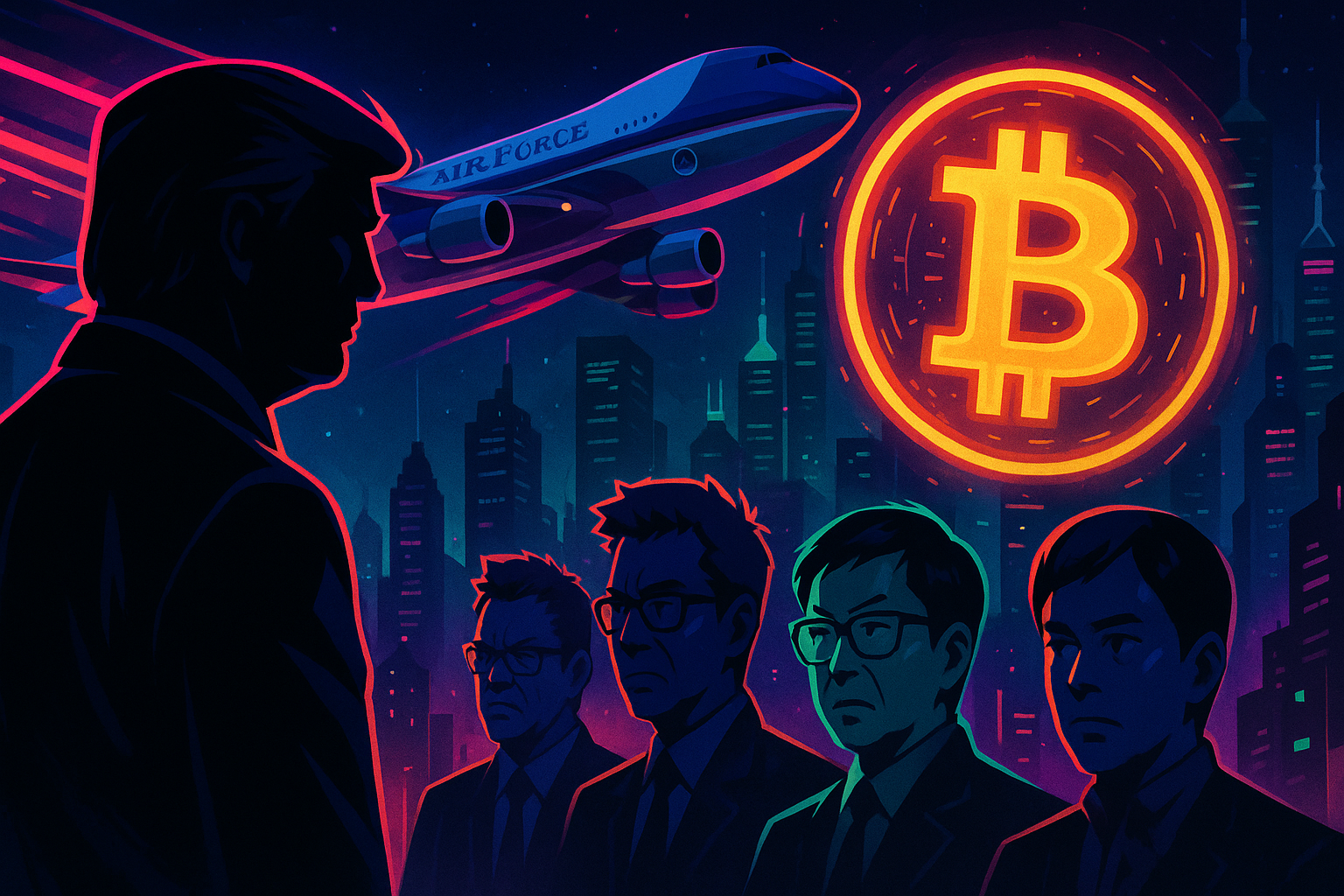
40% of the CEOs Trump Flew to China Have Crypto Ties — and Bitcoin Just Noticed
Trump boarded Air Force One for Beijing — and he brought the entire crypto-adjacent power structure of America with him. Elon Musk. Larry Fink. Jensen Huang. Tim Cook. Nearly 40% of the 16-CEO delegation flying to meet Xi Jinping has direct exposure to Bitcoin and digital assets. That’s not a coincidence. That’s a power move.
President Trump touched down in Beijing on Wednesday for a three-day summit with Chinese President Xi Jinping, joined by the most tech- and crypto-connected CEO delegation in diplomatic history. The talks — running May 13-15 — are nominally about tariffs, semiconductors, rare earths, and aviation. But for crypto markets, the subtext is deafening.
Bitcoin climbed to an intraday high of $81,000 on the news, testing its most significant resistance level in months.
The Delegation That Moved Bitcoin
Here’s who got on the plane — and why crypto markets care:
Larry Fink (BlackRock) — manages the world’s largest spot Bitcoin ETF, with over $50 billion in AUM. If anyone at that table is thinking about digital asset infrastructure as part of a US-China financial reset, it’s Fink.
Elon Musk (Tesla/xAI) — Tesla’s balance sheet holds 11,509 BTC. Musk also runs X, which has explored crypto payments, and xAI, whose compute demands depend heavily on the semiconductor supply chains at the center of these talks.
Jensen Huang (Nvidia) — added to the delegation as a last-minute confirmation on May 13. Nvidia chips power the AI and crypto mining infrastructure that both countries are racing to control. Every export control negotiation directly affects the hardware layer of the entire blockchain industry.
Tim Cook (Apple) — less directly crypto-exposed, but Apple’s App Store and Apple Pay are the final distribution layer for nearly every retail crypto app on the planet.
Bitwise strategist Juan Leon put the stakes plainly: “Reduced tariff risks could unlock $1 trillion in sidelined capital for crypto.”
What a Deal Actually Means for Crypto
The macro bet is simple. A US-China tariff de-escalation means:
-
Risk-on capital returns. Institutional money that parked in T-bills during peak trade-war uncertainty reallocates into higher-risk assets — including Bitcoin and digital assets. Analysts have pointed to trillions in sidelined institutional capital waiting for macro signals before rotating.
-
Semiconductor supply chains stabilize. GPU availability affects mining economics, AI agent infrastructure, and ZK-proof hardware directly. A deal easing export controls on chips to allied manufacturers would lower costs for every proof-of-work and proof-of-stake operation.
-
Stablecoin rails expand. A normalized trade relationship would make it politically easier for US payment stablecoin infrastructure to operate in Asian corridors currently blocked by geopolitical tension.
The flip side: China’s domestic crypto policy is not on the table. Beijing reinforced its crypto trading ban this spring and has no apparent interest in reversing it. Direct mainland Chinese Bitcoin demand remains off the table regardless of what gets signed.
The Other Shoe: CLARITY Act Vote Tomorrow
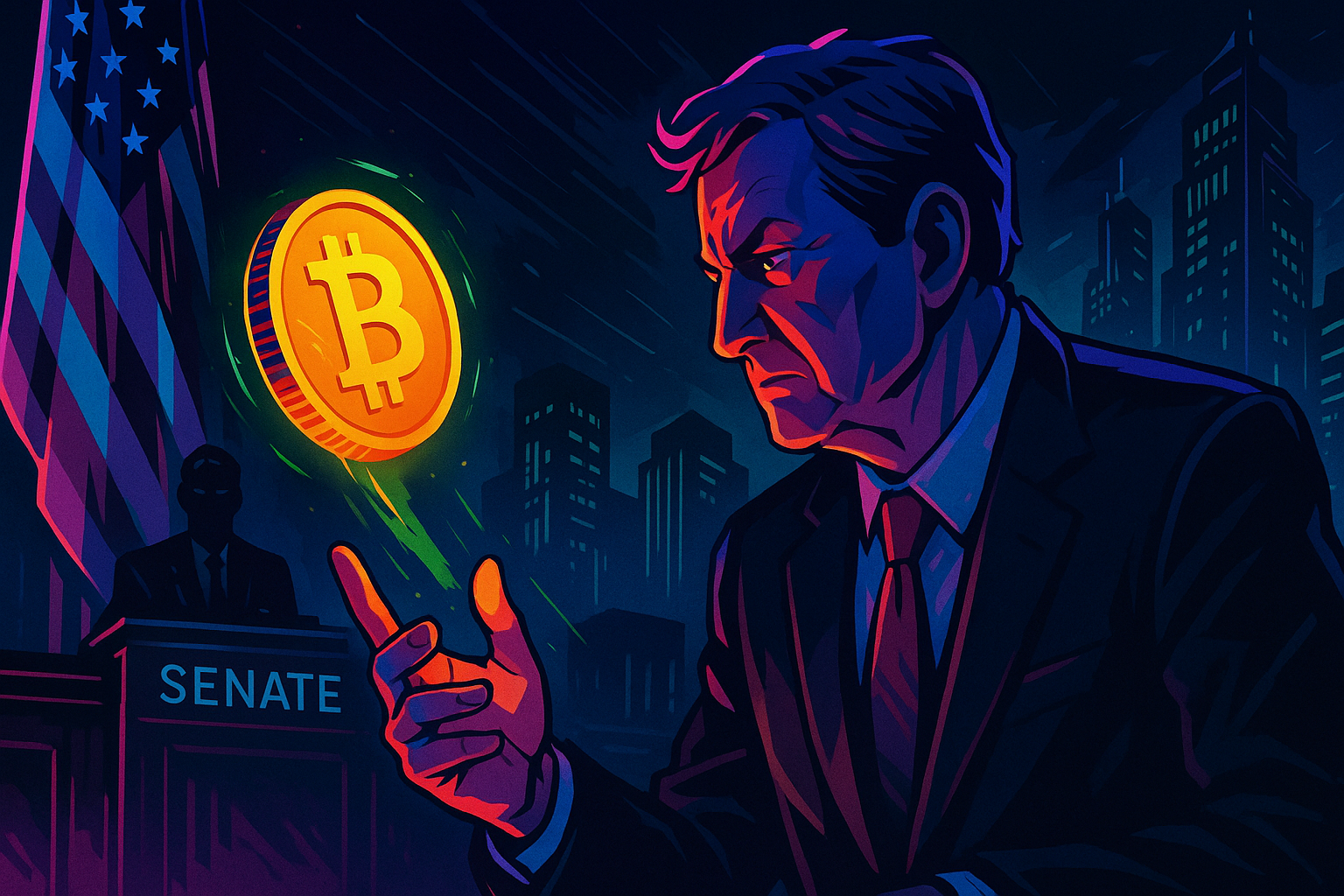
The timing is not an accident. While Trump is in Beijing, the Senate Banking Committee meets at 10:30 AM ET Thursday, May 14 to mark up the 309-page Digital Asset Market CLARITY Act — the most comprehensive crypto legislation ever put to a committee vote. Over 100 amendments have been filed, with Senator Elizabeth Warren alone submitting more than 40 aimed at blocking Fed master accounts for crypto firms.
Two massive catalysts landing in the same 48-hour window. If the Beijing summit yields a tariff framework and the CLARITY Act clears committee, Citi analysts project an additional $15 billion in net ETF inflows and their $143,000 base-case Bitcoin target comes into view.
If either collapses, Bitcoin stays rangebound at $80K.
Polymarket currently prices the CLARITY Act passing in 2026 at 75% odds.
Why This Matters for Crypto Jobs
This summit is a direct signal for where the next wave of crypto hiring will come from:
Institutional infrastructure. The executives on that plane — BlackRock, Goldman, Nvidia — are in active buildout mode on tokenized assets, settlement infrastructure, and AI-adjacent blockchain applications. A macro thaw accelerates those hiring timelines dramatically.
Compliance and regulatory. With CLARITY Act markup happening simultaneously, companies are scrambling to hire regulatory affairs, legal, and AML/KYC talent now — before the law passes and the compliance clock starts ticking.
Cross-border payments. A US-China economic framework, even a partial one, creates real demand for stablecoin payment infrastructure engineers, product managers, and BD hires with Asia-Pacific coverage.
On-chain AI. Jensen Huang’s presence signals that crypto and AI infrastructure are converging at the hardware layer. Engineers who understand both ZK proofs and GPU compute architecture are going to be extremely valuable in a post-summit hiring environment.
The Bottom Line
Forty percent of the most powerful CEO delegation in recent diplomatic history has skin in the crypto game. They didn’t fly to Beijing for the food. The next 72 hours could reset the macro environment for Bitcoin, stablecoins, and digital asset infrastructure in ways that a bull market alone cannot.
Watch the headlines. Watch the price. And if the deal comes through, dust off your resume — because institutional crypto hiring is about to accelerate.
Looking for your next move in crypto? Whether it’s a DeFi protocol, a tokenized assets desk at a TradFi bank, or the next AI-blockchain infrastructure play, the jobs are at cryptogrind.com. Search, apply, and get hired before the next bull cycle peaks.


Discussion
Comments are powered by GitHub. Sign in with your GitHub account to chime in.