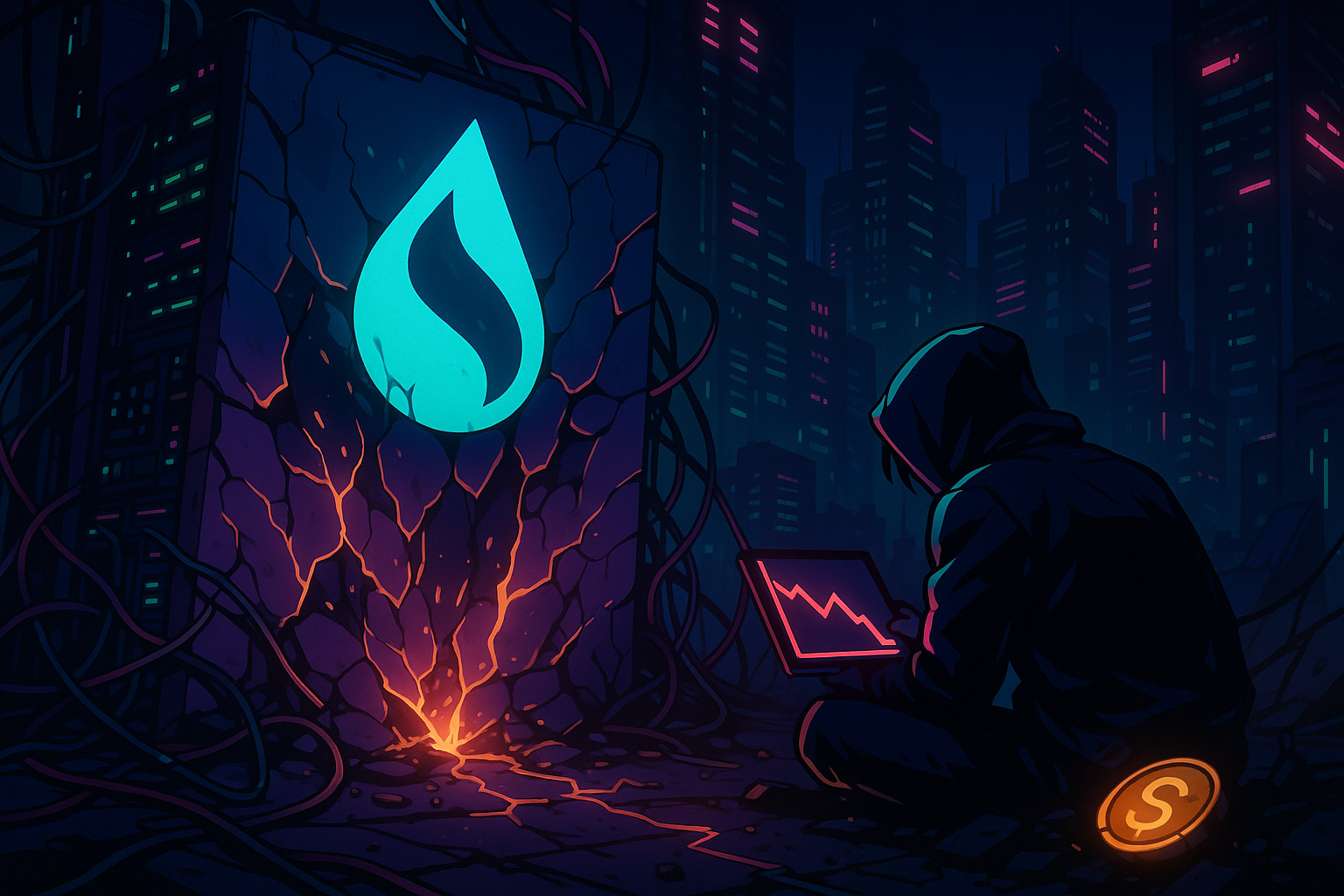
The 'World's Fastest Blockchain' Just Froze — Again
Speed is Sui’s whole brand. Sub-second finality. 297,000 TPS theoretical throughput. “The blockchain built for the real world.”
On Wednesday morning, the real world watched Sui stop producing blocks entirely.
What Happened
At approximately 7:15 AM PDT on May 28, 2026, Sui’s mainnet stalled. Explorers showed no new checkpoints, no new transactions finalizing — nothing. The Sui Core team posted to X within minutes:
“Sui Mainnet is currently experiencing a network stall. The Sui Core team is actively working on a solution. Be aware that transactions may be paused at this time.”
Engineers identified the root cause by 7:36 AM PDT — 21 minutes after the stall began. A post-mortem is expected to point toward a consensus or processing logic issue, though no official cause had been confirmed at press time. The network came back online roughly an hour later.
The native SUI token dropped approximately 8%, trading near $0.91 as traders reacted to the news.
This Is the Third Time
Let’s recap:
- November 2024: 2-hour outage traced to a scheduling bug
- January 2026: 6-hour consensus divergence — the longest outage since mainnet launch
- May 28, 2026: Network stall, ~1 hour of zero block production
Sui launched its mainnet in May 2023. That’s three major reliability incidents in under three years for a network positioning itself as critical financial infrastructure. The January 2026 outage was particularly rough — six hours during which approximately $1 billion in assets were inaccessible.
The good news: no funds were lost in today’s incident. Sui confirmed the network “halted safely” without risk of forks or fund losses. The bad news: “your money is fine, it just wasn’t accessible for an hour” is cold comfort when you’re running a DeFi protocol or an on-chain game with real users.
Why This Keeps Happening
Sui uses a custom consensus mechanism called Mysticeti, built on top of DAG-based consensus protocols. It’s purpose-built for speed. But speed and resilience are often in tension — the same architectural decisions that enable low-latency finality can create brittle edge cases at the consensus layer.
The January 2026 post-mortem described a “critical consensus disruption” — validators diverged from the canonical chain, which cascaded into a full stall. Whether today’s incident shares the same root cause is unknown, but the pattern is hard to ignore.
Mysten Labs, the company behind Sui, has $567 million in total value locked (TVL) in its DeFi ecosystem according to DefiLlama. That’s real money depending on this infrastructure.
The Broader L1 Reliability Problem
Sui isn’t alone. Solana has had multiple outage incidents over its lifetime (15+ documented stalls). Aptos — the other Move-language L1 — has faced similar scrutiny. Even the “older” chains aren’t immune: Ethereum’s beacon chain experienced a minority fork in 2023.
But the crypto industry has a short memory. Outages get shrugged off, the post-mortem drops two weeks later, prices recover, and builders keep building. The question is whether institutional capital — which has been quietly flowing into Sui’s ecosystem — has the same tolerance for downtime that retail degens do.
The answer is almost certainly no.
Why This Matters for Crypto Jobs
Network reliability incidents like this one have real downstream effects on hiring:
- Mysten Labs will hire. After every major outage, infrastructure teams expand. Expect job postings for senior consensus engineers, distributed systems specialists, and protocol security researchers. Watch jobs.sui.io and Mysten Labs’ careers page.
- DeFi protocols on Sui are re-evaluating risk. Builders who can architect around or migrate off a fragile L1 will be in demand — especially Move developers who understand both Sui and Aptos.
- Reliability engineering is hot again. Any L1 that keeps going down creates demand for SREs (Site Reliability Engineers) and chaos engineers who specialize in distributed consensus systems. These roles pay well north of $200K.
- The “multi-chain” narrative strengthens. Protocols that survive outages are the ones architected to be chain-agnostic. Full-stack Web3 engineers who understand cross-chain infrastructure are increasingly valuable across every ecosystem.
Move is still a differentiated skill. Sui’s ecosystem has 200M+ accounts and is backed by a16z. This outage stings — it doesn’t end the project. Builders who stay and fix the hard problems will be first in line when the next hiring wave hits.
Looking for jobs in the Sui ecosystem, DeFi infrastructure, or blockchain engineering? Browse open roles at Cryptogrind →

Discussion
Comments are powered by GitHub. Sign in with your GitHub account to chime in.