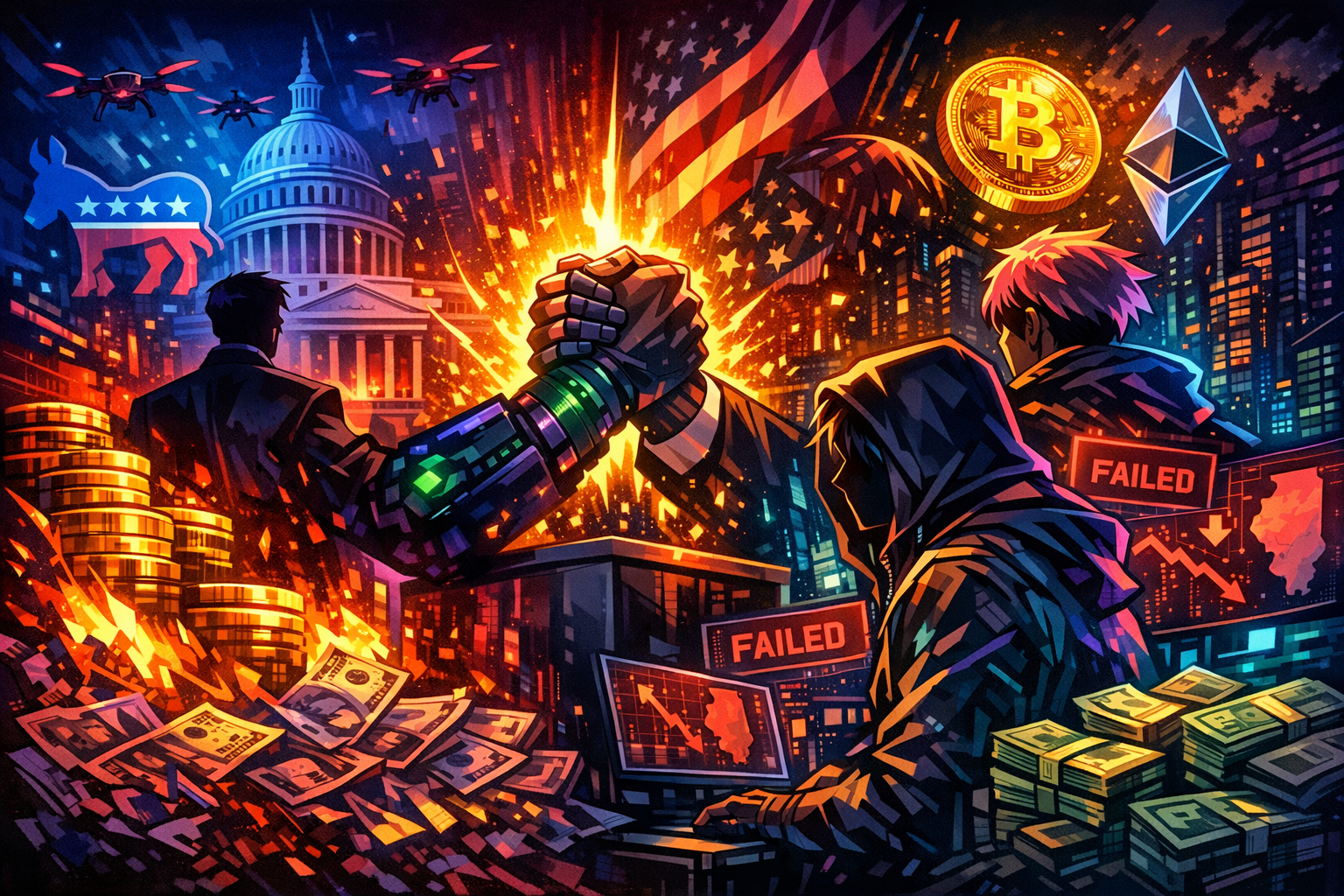
Crypto Spent $56M, a Third of Its Midterm War Chest, to Keep Sherrod Brown Out of the Senate. He Won by Nearly 5 Points
Crypto’s biggest super PAC put roughly a third of its 2026 ad budget into a single Senate race. The candidate it spent that money against is going back to Washington.
Fairshake, the super PAC funded mainly by Ripple, Andreessen Horowitz and Coinbase, says it spent about $154 million on campaign ads this year. According to CoinDesk, about $56 million of that went toward defeating Sherrod Brown in Ohio. Brown is the former Senate Banking Committee chairman the industry spent years treating as its main opponent in Congress.
On Tuesday night Brown beat Republican Sen. Jon Husted by nearly 5 points. Democrats also won majorities in both the House and the Senate.
What Happened
Pulled from CoinDesk, Reuters reporting summarized by crypto.news and Parameter, Cointelegraph via KuCoin and The Washington Sun:
- Ohio: Fairshake put about $56M into beating Brown, per CoinDesk. Counting all crypto-backed committees, Reuters-based reports put the total at more than $60M. Brown won by close to 5 points. It was the industry’s largest loss of the cycle.
- Illinois: Fairshake spent about $10M against Juliana Stratton in the Democratic Senate primary. She won the primary and then won the general election easily.
- Overall: Reuters puts total crypto PAC spending at about $176M across roughly 100 races, including primaries, up from more than $130M in 2024. Fairshake and its affiliates account for about $154.5M across 89 races.
- Win rate: Fairshake won 29 of the 34 races that had been called when Reuters counted on November 4.
- House losses: Among the 32 House incumbents Fairshake backed in the general election, Republicans Bryan Steil and Bill Huizenga both lost. Steil is a House Financial Services member, and crypto PACs spent $1.9M on his race. Elsewhere, Ken Paxton won his Texas primary runoff with crypto PAC support and then lost the general election to Democrat James Talarico.
- Wins: Pete Ricketts held his seat in Nebraska (CoinDesk says Fairshake spent $11M there). Fairshake’s picks Barry Moore (AL) and Andy Barr (KY) won Senate seats, and Democrats Christian Menefee (TX), Adrian Boafo (MD) and Jasmine Clark (GA) also won.
Brown made the race about crypto money. As Cointelegraph reported, he said:
“I’ll be damned if crypto billionaires decide this race."
"29 of 34” vs. “a Third of the Budget on One Loss”
Fairshake is pointing to its win rate. Spokesman Geoff Vetter said in a statement:
“Newly elected and current members will have a choice: protect consumers and American jobs or fight progress.”
The PAC also told CoinDesk: “We will be watching, and ‘28 is a new map.”
Ripple’s leadership is saying much the same thing. CEO Brad Garlinghouse posted: “New Congress, with the same mission: clear rules, built in America.” Chief Legal Officer Stuart Alderoty started his post with: “Let me be clear — some headlines will call this a setback for crypto.”
The record is mixed. Plenty of the 29 wins were safe seats and easy primaries. The races where the money was meant to change the result were Ohio, Illinois and Steil’s district, and Fairshake lost all three. Mark Hays of Americans for Financial Reform told CoinDesk:
“The industry definitely has some soul searching to do when it comes to how they approach politics.”
Fairshake isn’t out of money. Reports put its remaining cash for 2028 at about $56M, per CoinDesk and Reuters-based reports. Cointelegraph says more than $67M. Either way, the PAC has spent most of its money, and the Senate it spent against is the one it will be lobbying from January.
What It Means for Crypto Legislation
The CLARITY Act was already stalled. A Senate motion to begin debate on the market structure bill failed 49–50 in September. CoinDesk now expects a Democratic Congress, with Elizabeth Warren and Maxine Waters in stronger positions, to resist the big crypto bills. It says narrower issues, such as crypto tax treatment, could still move.
Brown’s role isn’t settled. It hasn’t been reported which committee he’ll sit on. Cointelegraph says Warren is in position to chair Senate Banking and speculates Brown could take a senior Agriculture Committee seat. Agriculture oversees the CFTC, which matters a lot for spot crypto markets. Treat that as speculation for now.
The GENIUS Act is already law. BitGo’s Mike Belshe noted that the new balance of power could delay legislation, but the stablecoin framework has passed and takes effect regardless. Brown’s past opposition to a stablecoin bill, which Wintermute’s Ron Hammond pointed out, can’t undo that law.
Why This Matters for Crypto Jobs
1. Plan around “no market structure bill before 2029.” Teams that were waiting on CLARITY before launching US products, hiring US staff or bringing token projects onshore will probably wait longer, or keep building offshore. In the near term, expect hiring to tilt toward the EU (MiCA), the UAE, Singapore and Hong Kong. The US openings will go to people who know how to work under existing SEC and CFTC rules.
2. Compliance, legal and policy staff now have more leverage. Without a federal rulebook, companies need people who can handle the current patchwork of guidance, no-action letters and state licensing. Former Hill staffers who know the new Democratic committee members are about to be heavily recruited.
3. Stablecoin hiring continues regardless. GENIUS is law, so implementation work like reserve management, attestations and bank partnerships goes ahead whatever the midterm result. Of everything in US crypto policy right now, it’s the most predictable place to build a career.
4. Industry political budgets are being reconsidered. After a $56M loss in one race, expect some of that money to go to lobbying, coalition work and in-house policy teams rather than TV ads. That means more policy, government affairs and advocacy jobs, both at companies and at trade groups like the Blockchain Association and the Crypto Council for Innovation.
The Bottom Line
Fairshake won most of its races. In the one it spent the most on, about a third of its ad budget, it lost to the senator it most wanted to beat. That senator returns in January to a Democratic majority that had already blocked the industry’s top bill in September.
The industry’s response is that 2028 is a new map. For anyone building in the US, it means planning for the next two years without a market structure law.
Not waiting two years for Congress? Teams building under MiCA, GENIUS-compliant stablecoin issuers and offshore protocols are hiring now, across engineering, compliance and policy. Browse open roles on Cryptogrind →



Discussion
Comments are powered by GitHub. Sign in with your GitHub account to chime in.